Common Mistakes to Avoid When Applying for Jobs in Dubai: A Complete Guide for Indians

Dubai has become a common career destination for Indian skilled workers. Professionals, such as construction workers, doctors, finance workers, sales professionals, and more, seek to work in Dubai. There are numerous employment opportunities within various industries. As with most things in life, securing a job in Dubai is not as simple as sending out job applications and hoping for the best.
Candidates make several common blunders in the early stages of overseas recruitment, from applying for the wrong position to sending a CV with typos. The risks of applying for jobs abroad are numerous, and the results can be detrimental, potentially leading to job seekers losing time and money.
The first step in planning your recruitment abroad should be to read about the dos and don’ts of recruitment abroad, particularly for Dubai. Whether an individual is a fresher, experienced, or skilled professional, an individual needs to be knowledgeable about the area.
Here we have collected common mistakes in Dubai job applications and included practical guidance for Indian candidates. Understanding mistakes when applying for Dubai jobs, following useful Dubai job application tips, and recognising Dubai job search mistakes for Indians can help you make informed decisions. This guide also explains common Dubai job application errors and shares overseas job search tips for Indian candidates so you can approach the process with greater confidence.
1. Applying for Jobs without Doing Any Background Research

Sending a job application without learning anything about the employer or the job itself is one of the most common blunders when it comes to applying for jobs in Dubai. Many job seekers think that sending an enormous number of applications is the best way to get hired. But there are two main problems with that thinking:
First, sending many applications does not improve your chances. Most recruiters will notice a barrage of applications and simply discard them, as will any applicant tracking system.
Second, applying for too many jobs will prevent an individual from tailoring each application to a specific position. A targeted application is the best application. Each position needs to be addressed and framed appropriately, especially if the employer is outside the United States.
How to Avoid This Mistake
Look closely at the job description, including the qualifications and technical skills required, as well as the number of years and specific duties expected. Investigate the company, its mission, what it does, and where it’s located, among other things.
As an example, if a job opening is for an engineer, applicants should ensure that the company has a requirement for certain technical certifications or experience within the field. In the same way, those in the hospitality field should examine what it takes to perform the role as laid out.
Compile a list of jobs an individual is eligible for and customise your applications to fit them. When done well, an individual can make themselves more marketable to potential employers.
2. Sending the Same CV to Multiple Jobs in Dubai

Another typical error job hunters make in Dubai is sending out a generic CV. It’s often the case that an individual will send a CV to a multitude of jobs even though the requirements of those jobs are entirely different.
To give an individual the edge over your competition, ensure your CV stands out and clearly communicates how well your experience matches the requirements of that specific job. Even if you’re qualified, a poorly tailored CV is unlikely to get a second look.
Dubai CV Writing Tips for Indian Job Seekers
For best results with your applications in Dubai, follow these CV writing tips:
- CV Customisation: Complete your CV by including all of your relevant skills and experience, as well as your educational and professional background.
- Use a Clear CV Structure: Include sections like a professional summary, your work and education, and your technical skills and certifications.
- Highlight Measurable Results: When an individual can, use facts to support the claim, such as project results, sales figures, and operational achievements.
- Use relevant keywords: Mention the important skills and terminology related to the vacancy when appropriate.
- Be honest: Never inflate your achievements, your job title, or your past salary, nor your work history or experience.
Use good grammar and check the formatting. Using headings and a font that is easy to read adds to the professional nature of your CV.
For example, a person looking for an accounting job might want to mention financial reporting and reconciliation and their expertise in accounting software, as well as their compliance knowledge. For a civil engineer, project implementation, site oversight, drawing of diagrams, and knowledge of safety protocols are key.
Include the contact details, state the candidate’s current location, and availability in the appropriate cases.
When your CV is done and the details of the job have been noted, a recruiter is better prepared to assess whether you’re the right candidate for the job.
3. Ignoring Dubai Job Eligibility Requirements
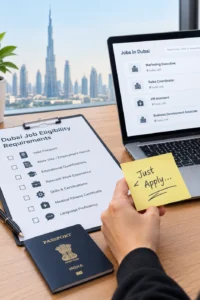
Many applicants fail to research a job’s eligibility requirements. Often, Dubai employers will demand specific academic credentials and a certain number of years in the job, in addition to professional licences, technical credentials, and even languages.
Regulated jobs in the UAE may even require applicants to be recognised in their trade and receive an endorsement by a UAE agency, depending on the job.
How to Check Eligibility
Before an individual submits their application, make sure to check:
- Qualifications that cover education, and in particular, job-related specialities.
- Work experience in a specific trade for a certain number of years.
- Required professional credentials or licences for your trade and a professional trade credentials’ equivalency.
- The communication and trade language skills required for the trade.
- Specific conditions or requirements that the job may have in addition to the ones that were already listed.
As an example, someone in the medical field may need a certain number of years of experience in the UAE that is trade-related, along with other professional licences, a credentialed education, and communication skills in the trade.
Before applying, compare your background with the advertised Dubai job eligibility requirements. Also prepare the documents required for Dubai jobs, which may include a valid passport, updated CV, educational certificates, experience letters, and professional licences where relevant. Requirements differ by role and authority, so confirm whether qualification attestation or additional approvals are needed before paying for document services.
4. Missing the Mark When Applying for Jobs in Dubai From India

Job seekers often overlook the recruitment process. They may be unfamiliar with document requirements and how employers evaluate job applications, or even what comes after a job offer.
Because they aren’t familiar with the process, many applicants end up losing valuable time by not attending job interviews or not submitting job applications. Other applicants find themselves making payments to job recruitment intermediaries.
How to Properly Apply for Jobs in Dubai for Indians
While the process varies by employer and job type, this guide explains how to apply for jobs in Dubai from India using a practical, step-by-step approach. Following these Dubai job application tips can help you organise applications and avoid preventable delays.
- Step 1: Start finding job openings. Look at all job sites, including individual employer sites, job aggregators, and even job placement sites.
- Step 2: Start getting all your documents ready. Revise and edit your CV, and start getting all your credentials, diplomas, and certificates for employment and school.
- Step 3: When applying for jobs, use ONLY direct links on employers’ websites or from verified, reputable job placement sites.
- Step 4: Once an individual gets to the job interviews, start preparing answers to potential behavioural and general job-related interview questions. Make sure an individual also starts getting a great story together of why an individual should be chosen for this job and be prepared to negotiate their salary.
- Step 5: Verify the offer to make sure it is a legitimate offer. Verify everything about the offer.
- Step 6: There is a little more paperwork to finish in order to begin employment. Sign the documents and verify that your employer has finished the visa paperwork.
In the UAE, an individual is required to have an official employment offer before an individual can accept any work in the private sector. Once an individual gets an employment offer, there are different formalities for each employer and employment type to obtain a work permit and accept employment.
5. Falling Victim to Fraudulent Recruitment Agents and Consultancies

Some recruitment agents can help candidates find employers; however, there are plenty of others that aren’t legit. Fake agents lure candidates with overseas job openings, quick employment hiring, high salary offers, and sometimes a money-back guarantee, to try to get money from applicants.
Choosing the wrong Dubai recruitment agency is the biggest mistake an individual can make.
The following suggestions can help verify a Dubai recruitment agency for Indian candidates:
- Confirm if the agency is legal and licensed. Verify their address and their ability to conduct recruitment activities.
- When choosing a recruiting agent in India to organise your employment overseas, check whether or not the agency is registered through the Indian Government eMigrate portal.
- Find out what the name of the employer is, along with the job description and the proposed recruitment terms.
- Try to find the employer to make sure that the job and recruitment process are real.
- Make sure that an individual gets receipts and explanations in writing for all legal fees.
- Be wary of agencies that aren’t transparent or attempt to make an individual pay for a service.
It is best to go with a registered recruitment agent. In fact, if an individual wants to leave the country for work, they should follow the Ministry of External Affairs’ recommendations. In addition, try to find out as much information as possible about the prospective employer before agreeing to any offer. If needed, find out more about your recruitment agent through their official website.
Candidates can visit the eMigrate portal and the MEA overseas employment guidance for further information.
Important: Verification requirements depend on the recruitment arrangement. An agency’s professional-looking website or social media presence is not sufficient proof of legitimacy.
6. Understanding Scams and Fake Dubai Job Offers
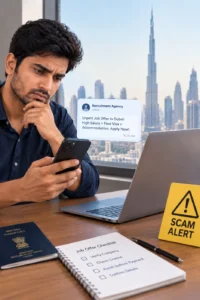
Scams and fake offers for jobs in Dubai happen all too often, and job applicants should be aware of these types of schemes before they start looking for overseas employment. Job scams take a few different forms and typically include someone masquerading as a legitimate company, using an official-sounding job posting, or emailing potential job applicants.
Some scammers promise potential applicants an unrealistically high salary, the quick and easy approval of their visa application, and the provision of accommodation, all without having to undergo a legitimate recruitment process.
In October 2026, The National ran a story regarding warnings from Indian missions in the UAE about the rise in overseas recruitment scams and fraudulent services related to visa processing. They highlighted the importance of applying for jobs only through officially recognised channels.
Recruitment Fraud Warning Signs
Some red flags include if the person:
- Offers a job to an individual right away, and they didn’t really go through any selection process with you.
- Says that an individual needs to pay them to set up an interview or give an individual a letter for an appointment.
- Is emailing you, or sending an individual to a website, for a business other than the company that the person says they are working for.
- Doesn’t tell an individual the full name of the company or any information about the company at all.
- Offers an individual a great compensation package for the job, without even giving an individual any details about the role.
- Says an individual needs to pay them for the position, and there is no legal reason to justify the payment or the request to put the money in their personal bank account.
- Wants an individual to start travelling for the job but hasn’t even given an individual the correct documents for the employment.
Recruitment practices that seem out of the norm may not be inherently fraudulent. However, if a few warning signs are combined, an individual should probably stop and investigate.
A Checklist for Indians Seeking Jobs in Dubai
Follow the points listed below before moving forward with an opportunity to work abroad.
- I know about the employer and have read the job description.
- I have edited my CV and made it more specific for this particular job, and ensured all the information in my CV is true.
- I am confident in my ability to meet the requirements of this role and am comfortable with my previous experience.
- If needed, I have examined the credentials of the agency and feel secure in working with them.
- I know that both the prospective employer and the offer are genuine.
- I know the rules regarding the work visa, entry permit, and the required documents for the visa.
- I know exactly which documents will be needed for the job, and I have all of them.
- I have read the contract in detail, including all the salary details and working conditions.
- I haven’t made payments to a suspicious person or for an unverified service.
- I am prepared to give an interview and have saved every correspondence, even the important ones.
- Before setting off on a new career abroad, I’ve double-checked all the logistics of my employment and travel plans.
These measures won’t protect you from all eventualities. However, they will teach you to notice any suspicious activities and to make decisions that are more informed.
Final Remarks
Searching for a job in Dubai is a worthwhile endeavour, as it provides a valuable step in your international career and professional development. Nonetheless, to be successful, it is essential that you remain realistic and careful and that you prepare and know the steps in the recruitment process.
In order to avoid typical pitfalls while applying for jobs in Dubai, you should avoid:
– Using the same CV for all jobs.
– Not paying attention to job eligibility criteria.
– Relying on job agencies that have not been vetted.
– Falling for job offers that are too good to be true and for which you have to pay upfront.
– Not having a good understanding of the job’s visa requirements.
– Signing employment contracts without fully reading them.
Indian applicants who follow these simple guidelines to verify and document every aspect of the hiring process and whose research focuses on companies for positions for which they qualify are well-positioned to find success in their Dubai career quest.
At Masakien Al Amna International, candidates can explore overseas recruitment opportunities and seek information about available positions and recruitment requirements. Always verify the details of a specific vacancy, the employer, and the applicable employment procedures before making a commitment.
Frequently Asked Questions (FAQs)
Q1. What are the errors I need to watch out for when looking for work in Dubai?
One of the errors you can avoid is sending the exact same CV, applying for jobs for which you are not the best fit, not examining a firm, or not engaging a recruitment firm. Another mistake is to accept an offer before having a careful look at all the terms and conditions and making an exorbitant cash expenditure. You can do some groundwork by exploring all possible options, being very careful with suspicious job offers, and making sure everything else is in place.
Q2 What is the safest method of job seeking in India?
Start by finding a job through the career pages of companies, reputable job portals, and other means. Be original and prepare your CV yourself. Explore the employer, authenticate the job offer, and ensure that the employer has taken all necessary steps concerning your visa and other employment processes.
Q3 How do I authenticate a job offer in India?
You can cross-check the employer details from outside the job offer and include the job designation and remuneration, as well as the location. Ensure the agency for recruitment is verified and also holds a licence. In case the job offer comes from the private sector, confirm it with the Ministry of Human Resources and Emigration (MoHRE). In case of an offer from a free zone, check with the concerned authority. PDF job offers are not reliable on their own.
Q4 Which documents are necessary for job searches in Dubai?
Generally, you will require an updated passport and a copy of your current CV, along with any documents regarding your educational and professional achievements. Additional documents could be requested by an employer and can even be required by the laws of a specific jurisdiction. Certain occupations, for example, might need an attestation of documents concerning your qualifications. It’s important to clarify the requirements before going to the time and expense of attesting your documents.
Q5 Is it a requirement to make payments to recruitment agencies in Dubai?
Prospective employees in Dubai should be vigilant when considering an employment agency, as it is unlawful to make payments for their recruitment services. Instead, the agencies should be paid for their services by the hiring company. Any prospective employer should be cautious when working with a recruitment agency that makes an explicit request for payments to obtain a job.